Greyhounds: Aristocrats on Four Legs, Speed Demons at Heart
By D.G. · 2 November 2026 · 8 min read
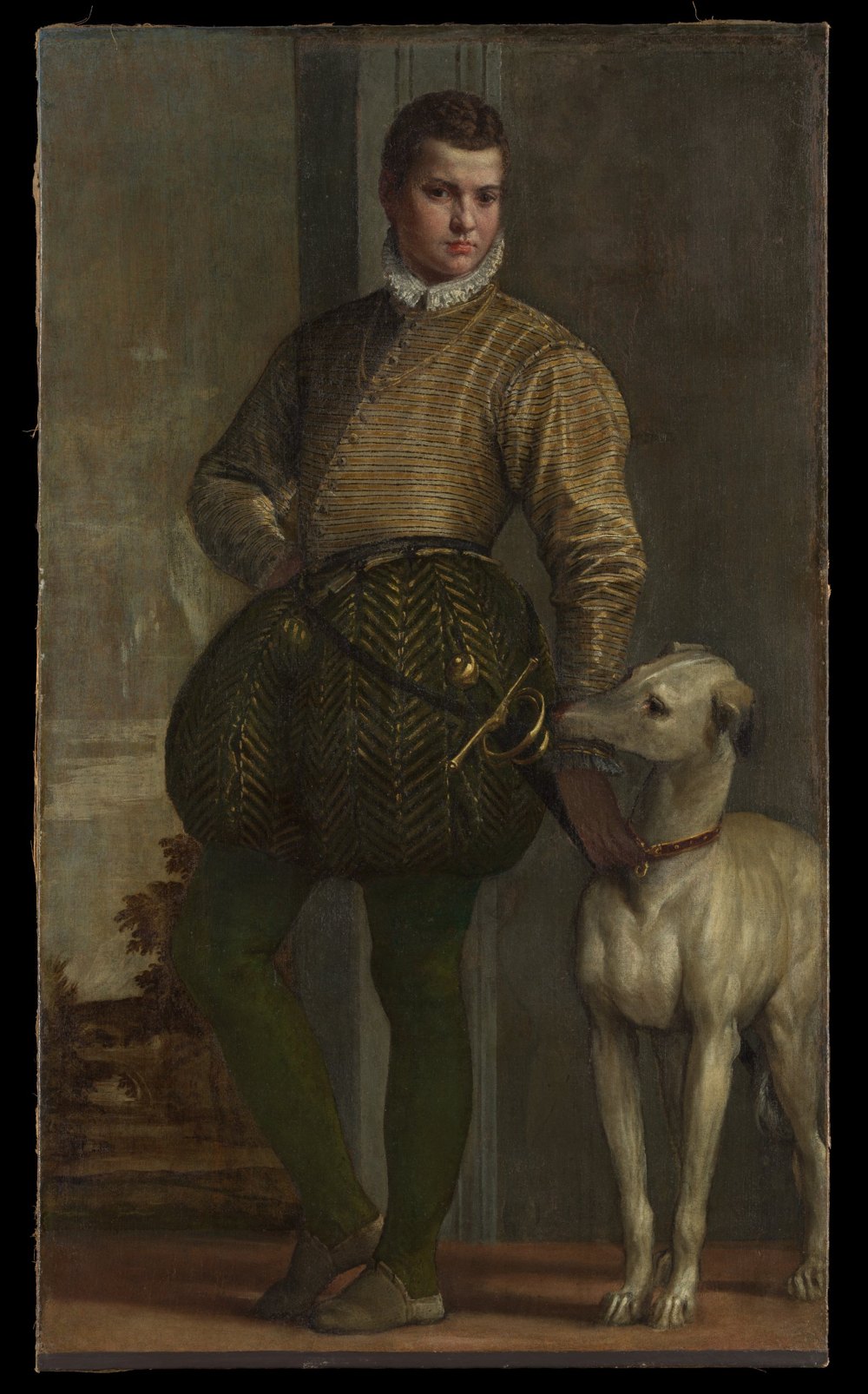
Paolo Veronese, Boy with a Greyhound, c. 1570s. Oil on canvas. The Metropolitan Museum of Art.
Take a look at portraits of the Russian czars posing with their favorite pets. You’ll notice a recurring character: a dog with an athletic physique, an elegantly chiseled face, and a beautifully groomed puff of hair. Its expression says, “Yes, I am magnificent. No, I don’t care whether you agree.” Clearly, this is no ordinary dog. This is a Greyhound—or, more precisely, its Russian cousin, the Borzoi, who looks as though it was born wearing a royal title.
The Royal Kennel Club of England recognizes around 220 dog breeds, but Greyhounds belong to a particularly ancient canine dynasty, with a lineage stretching back roughly 5,000 years. These dogs are easy to recognize: long, lanky bodies, narrow waists, and ribcages that seem to have been designed by an engineer with ambitious plans for the heart and lungs. And for good reason! Greyhounds can reach astonishing speeds of around 45 miles per hour (72 km/h). They are essentially four-legged sports cars—except that they occasionally prefer to spend the afternoon on the sofa.
Their ancestors appear in ancient Egyptian art, including the walls of tombs and pyramids. In other words, while some dogs were still working on their basic introductions, Greyhounds were already making their way into civilization’s most prestigious real estate.
But here’s the surprising part: the Greyhound family is not just one elegant face in eight slightly different outfits. These sight-driven hounds come in eight distinct types, each shaped by its homeland, climate, and hunting traditions. Think of them as an international aristocratic family: all related, all leggy, but each with its own wardrobe requirements and regional personality.
1. The Russian Borzoi: Speed with a Side of Snobbery
Let’s begin with the Russian Greyhound, the Borzoi. Its name comes from a Russian word meaning “swift” or “fast”—a fitting title for a dog that can move like a streak of silk across the countryside. Its speed might even remind you of the Velociraptor, whose name means “swift thief” and whose fossils date to roughly 75–71 million years ago, during the Late Cretaceous period.
Of course, the Borzoi has one major advantage over its prehistoric namesake: a magnificent coat and an expression suggesting that it has never stolen anything in its life. It has merely appropriated what was rightfully beneath its dignity.
With its long, silky, often wavy fur and tall, slender frame, the Borzoi is well equipped for Russia’s brutal winters. Its luxurious coat serves a practical purpose, although you could be forgiven for thinking it was commissioned by a czar’s personal fashion designer. Beneath that flowing elegance is a powerful hunting dog built for speed, endurance, and spotting prey from a distance.
The Borzoi’s overall appearance is so aristocratic that one suspects it considers an ordinary dog walk a royal procession—and expects the neighborhood squirrels to bow.
2. The Sloughi: Desert Elegance, No Fur Coat Required
Now travel south to the warmer, drier landscapes of North Africa, where we meet the Sloughi, a graceful sighthound associated with Morocco and other parts of the Maghreb.
Unlike its Russian relative, the Sloughi has a short, sleek coat and a leaner silhouette—an outfit better suited to the desert than a Siberian winter. If the Borzoi is dressed for a royal winter ball, the Sloughi has arrived in tailored summer wear, ready to cross the desert without breaking a sweat. Well, almost.
The Sloughi’s name is often linked to regional Arabic and North African naming traditions. More importantly, this breed belongs to the ancient tradition of hunting dogs that rely primarily on sight rather than scent. Its keen eyes detect movement across open terrain, and its long legs help it pursue prey at remarkable speed.
While many other dogs approach the world nose-first, investigating every bush as though conducting a criminal investigation, the Sloughi prefers to look first. Why sniff every inch of the landscape when you can simply spot the suspect from across the dunes?
Elegant, reserved, and athletic, the Sloughi is another reminder that nature has a sense of humor: it created a dog capable of running like the wind, then gave it an expression that suggests it would rather not discuss the matter with you.
And so, from the snow-covered estates of Russia to the sun-baked landscapes of North Africa, the Greyhound family demonstrates that speed may be universal—but style, as always, depends on the climate.
3. Spanish Greyhounds
Of all the greyhound varieties, the Spanish Greyhound may have one of the longest family trees stretching back to the dogs of ancient Egypt. Geneticists suspect these elegant speedsters arrived in Spain around the 2nd century CE, where they adjusted to the local climate without feeling the need for a complete makeover. Apparently, when you’ve perfected your body shape over thousands of years, there’s no reason to follow fashion trends.
4. Afghan Hounds
Ah, the Afghan Hound! With silky hair framing those striking facial features, it looks as though it has just stepped out of a luxury shampoo commercial. Bred in the mountains of Afghanistan, this variety is often considered one of the most beautiful members of the greyhound family. It is the supermodel of the group: elegant, photogenic, and probably unwilling to go outside on a windy day without consulting a stylist.
5. Persian Greyhounds
Known as Salukis, these elegant athletes were bred for hunting across the arid plains of Iran. They are among the fastest dogs around, and their Persian name is said to mean “one gallop”—which seems a rather modest way to describe an animal that can disappear over the horizon before you’ve finished tying your shoelaces. With roots tracing back to ancient Egyptian dogs, they are also close relatives of the Arabian variety. Clearly, speed runs in the family.
6. Italian Greyhounds
Small, short-haired, and irresistibly elegant, Italian Greyhounds make excellent companions. They have also enjoyed considerable popularity among royalty and the nobility. And why not? They’re practically pocket-sized aristocrats, perfectly suited to lounging on velvet cushions and looking disappointed when served anything less than a royal dinner. Their only real flaw is that they may mistake your lap for a permanent throne.
7. Scottish Greyhounds
Meet the Scottish Deerhound: the gentle giant of the family. With a large frame, shaggy, wiry coat, and a weight that can reach around 110 pounds, this fellow is built for serious business—namely, hunting the magnificent red deer. Unlike its sleek, polished cousins, the Deerhound looks as though it has just returned from a long hike through the Highlands and hasn’t had time to brush its hair. But beneath that rugged exterior lies a dignified companion who can make even a king-sized sofa look surprisingly small.
8. Whippets
Whippets, sometimes called English Greyhounds, are among the smaller members of the greyhound family. With softer facial features and a sweet, gentle expression, they look less like professional athletes and more like dogs who would apologize for accidentally stealing your sandwich. Don’t let those innocent eyes fool you, though. Beneath that sweet face is a remarkably fast runner who can go from peacefully curled up on the sofa to vanishing across the garden in the blink of an eye. Think of them as the family’s adorable little sprinters—with a serious talent for looking innocent afterward.
Which Breed of Greyhound Suits Me Best?
Ah, an excellent question! But hold your horses—or, more appropriately, hold your hounds!
For centuries or even thousands of years, Greyhounds were the canine equivalent of luxury sports cars: elegant, prestigious, and owned by kings, queens, and aristocrats who wanted everyone to know they had excellent taste and a very fast dog. Back then, these graceful creatures weren't exactly bred to snuggle under a blanket and binge-watch Netflix. No, they had a job to do! Greyhounds were bred to hunt, serving as the royal hunting companions. Their natural instinct to chase anything that moves made them superb hunters and, eventually, stars of the dog-racing world. Although commercial dog racing is banned in many countries, it is still permitted in places including Australia, Ireland, Mexico, the United Kingdom, the United States, and Vietnam, subject to local laws and regulations.
Now, here's where things get interesting. A Greyhound's legendary need for speed comes with two important considerations. First, these dogs need regular opportunities to stretch their long legs and burn off some energy. Fortunately, they aren't marathon runners who demand a 10-mile jog before breakfast. A good sprint followed by an impressive amount of sleeping usually suits them just fine. In fact, a Greyhound can go from Olympic sprinter to professional couch potato faster than you can say, "Who's a good boy?"
Second—and this is a rather important but—their instinct to chase moving objects can sometimes get them into trouble. A small child dashing across the garden, a cat making a suspiciously quick getaway, or a rabbit hopping past might accidentally trigger their inner hunting champion. What looks like a harmless game of tag to the family could look like the final event at the Greyhound Olympics to your dog. Careful supervision, secure spaces, and appropriate introductions to children and other pets are therefore essential.
So, before you welcome one of these four-legged racing legends into your home, give the decision some serious thought. After all, choosing a Greyhound isn't just about finding a dog with a magnificent profile and supermodel legs. It's about finding a companion whose instincts, exercise needs, and lifestyle fit yours. Because the perfect Greyhound should steal your heart—not turn your cat into a contestant on The Amazing Race!