The Secret of Puppy Love
By D.G. · 8 July 2026 · 5 min read
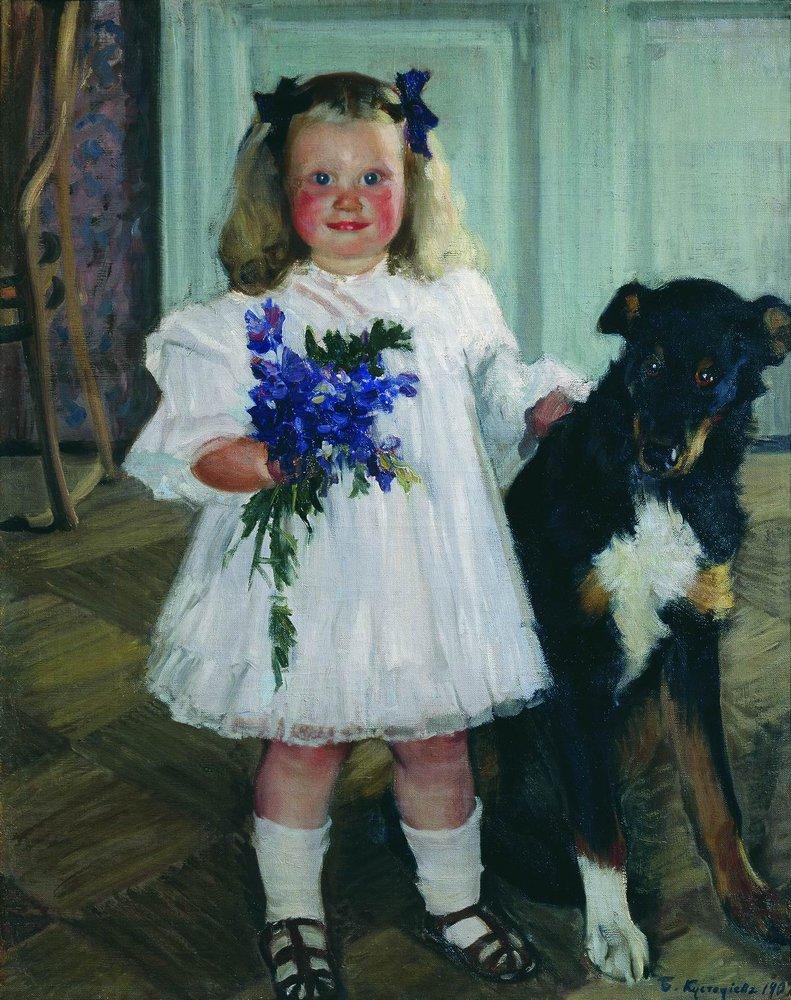
Boris Kustodiev, Portrait of Irina Kustodiev with the Dog Shumka, 1907. Oil on canvas.
“Awwww…” That’s it. That’s the entire vocabulary of the human race the moment a puppy enters the room. Scientists call it a “universal human response.” The rest of us call it completely losing our minds over a fluffy creature that has done absolutely nothing to earn our devotion — yet.
The same thing happened to me when my children were babies. My friends and neighbours would go nuts over them. Coincidence? Certainly not.
Have you ever stopped mid-“awwww” to wonder why we react this way? We get the baby thing — they’re ours, they look like us, society expects us to love them. But puppies? They’re essentially tiny wolves with better PR.
The eyebrow that changed everything
Here’s the secret: it all comes down to a sneaky little group of facial muscles called the inner eyebrow raise. These magical muscles allow dogs to make expressions that speak directly to our souls — you can look at their furrowed brows and know when they are happy, worried, or doing that heartbreaking “please don’t leave me” face as you grab your car keys.
If you want to sound insufferably educated at your next dinner party, go ahead and call these muscles by their Latin name, Levator Anguli Oculi Medialis. Drop that casually into conversation and watch heads turn.
Now here’s the plot twist: horses have these muscles too. And the runner-up in popularity, a very smug domestic furry friend, decidedly does not.
Cats.
Shocked? No, you shouldn’t be. You own a dog or a horse, but it is the cat that chooses to own you. And they don’t have the required facial muscles to reflect their emotions.
The experiment in Siberia
Our love affair with dogs goes even deeper than facial muscles. Nearly 70 years ago, in the then Soviet Union — where genetic research was about as welcome as a stray dog at a dinner party — a remarkably brave scientist named Dmitri Belyaev quietly set up shop in a remote corner of Siberia and started one of history’s most fascinating experiments.
He gathered a group of wild silver foxes and played a very selective game: who’s a good boy? The aggressive ones were released. The calm, friendly ones were kept and bred. Then, from each new litter, only the friendliest pups made the cut. Repeat. Repeat.
Within just a few generations, something almost magical happened. The foxes began to change — physically. They developed white patches. Their ears went floppy. Their snouts shortened. Their faces became rounder and more babylike. They started wagging their tails. And more importantly, they started making eye contact with humans.
Essentially, by selecting for friendliness, Belyaev accidentally hit the “make them adorable” button.
Remember Little Red Riding Hood nervously noting her grandmother’s very long snout and very sharp teeth? She was onto something. Wolves — dogs’ ancestors — have exactly those: long noses, sharp teeth, intimidating features. Belyaev’s domesticated foxes lost all of that. They traded consummate predator for please adopt me.
And the joy is entirely mutual
Neuroscientists have discovered that when humans and dogs meet, both brains get flooded with oxytocin — the so-called “love hormone.” That’s right: your puppy is just as chemically besotted with you as you are with them.
You are both, scientifically speaking, absolutely losing it over each other.
So the next time a puppy trots into your life and you find yourself making undignified baby noises and offering your entire heart to a creature you met thirty seconds ago — don’t fight it.
Science says it’s our destiny. Tens of thousands of years of co-evolution conspired to make dogs and humans family.
Go ahead. Go crazy with love.
Kaminski, J. et al. (2019). Evolution of facial muscle anatomy in dogs. Proceedings of the National Academy of Sciences, 116(29): 14677–14681.
Belyaev, D.K. — fox domestication experiment, Institute of Cytology and Genetics, Novosibirsk (ongoing from 1959).
Nagasawa, M. et al. (2015). Oxytocin-gaze positive loop and the coevolution of human-dog bonds. Science, 348(6232): 333–336.