How did dogs become our friends?
By D.G. · 29 May 2026 · 5 min read
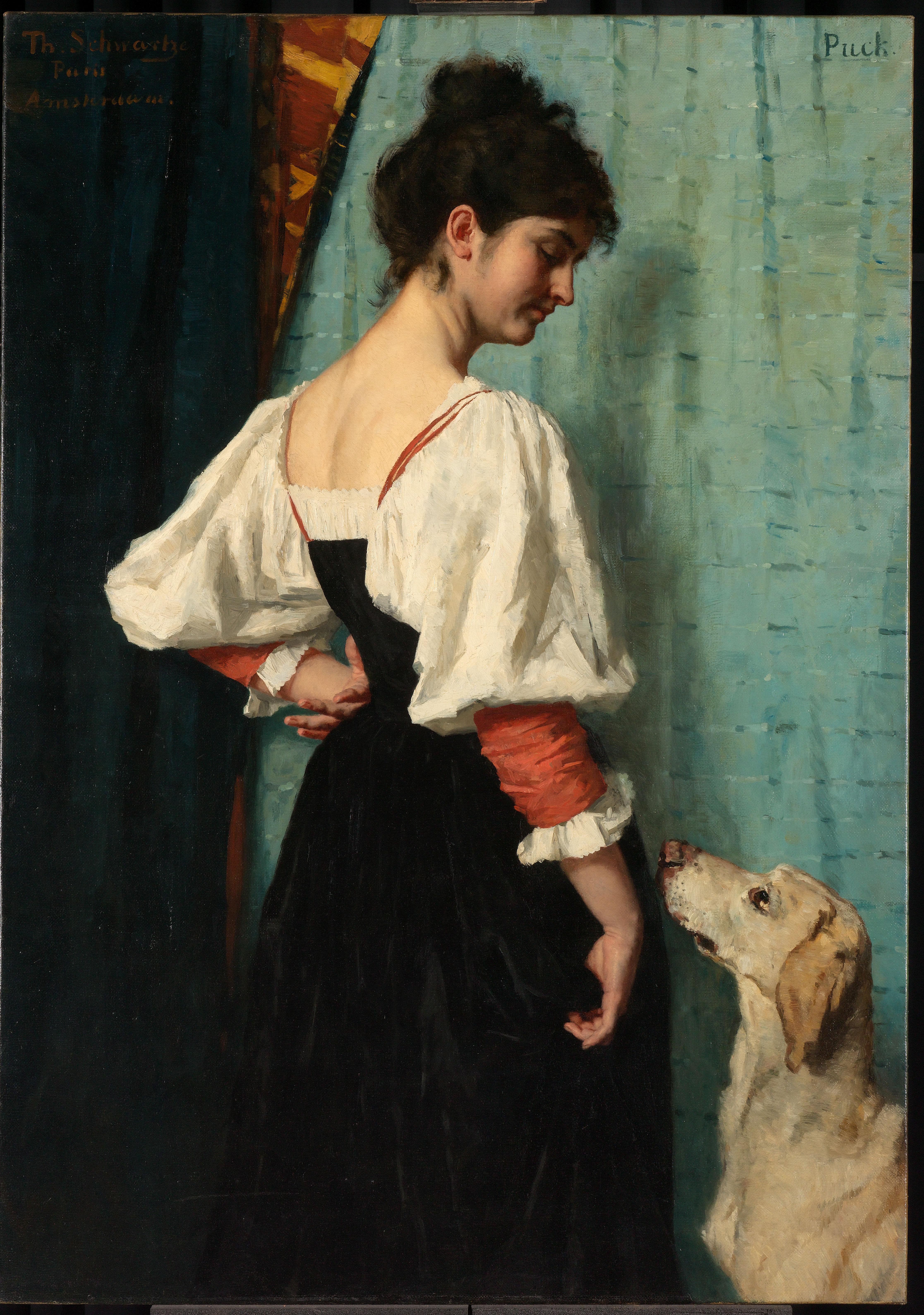
Thérèse Schwartze, Portrait of a Young Woman, with Puck the Dog, 1879. Rijksmuseum, Amsterdam.
So, you brought home a puppy. Not just any puppy — oh no. The most heart-meltingly, ridiculously adorable creature to ever set four paws on this earth. Congratulations. Your life, as you knew it, is over. In the best possible way.
Before we talk about whose turn it is to clean up the "accident" on the rug, or being chewed up by needle-sharp puppy teeth, let's tackle the bigger question: how did dogs worm their way into our hearts, our homes, and eventually, our beds?
How did wolves end up at our fire 40,000 years ago?
It all starts about two million years ago — long before designer dog collars and Instagram pet accounts. Wolves roamed the Eurasian forests, trying to make a living. Hunting was their first option. The problem? Prey has opinions about being eaten. It runs. It flies. It fights back. A wolf could end up wounded, humiliated, or worse — hungry.
So naturally, like any sensible creature, wolves thought: why work hard when you can scavenge?
Scavenging, of course, came with its own complications. Trying to steal a half-eaten antelope from a cave bear is not exactly a low-stress Tuesday. But then the wolves noticed something interesting: humans. Early humans were skilled hunters, cooked their food over fire, and — crucially — were picky eaters. They didn't like to eat predator meat. Too gamey. Too risky. Hard pass. The wolves, however, had absolutely no such reservations. Free cooked meat, delivered daily? They were in.
So the early wolves did what any rational freeloader would do: they followed the humans, kept a polite distance, and helped themselves to the leftovers. A mutually tolerable arrangement.
Why did some wolves come closer than others?
This is where it gets interesting. Wolves, like people, have personalities. Some were aggressive. Some were timid. And some — perhaps around 40,000 years ago — were just friendly enough to inch a little closer to the campfire. Maybe a curious child reached out a hand. Maybe a bold wolf sniffed it. Nobody wrote it down, but ordinary moments like that may have changed history.
Over generations, the friendlier wolves began to look different. The long, sharp snouts softened. The menacing eyes grew rounder, warmer. They started looking less like apex predators and more like something you would want to cuddle. Evolution, it turns out, rewards being likeable.
What did dogs actually give us in return?
The arrangement became a proper partnership. The wolves-turned-dogs got steady meals and a warm fire on cold nights. In return, they offered something priceless: that nose. A dog's sense of smell is anywhere from ten thousand to a hundred thousand times more powerful than ours — meaning your dog knew what you had for lunch before you walked through the door. They became hunters, load-pullers, companions, and in modern times, crime-stoppers.
We gave them love, care, and an embarrassing number of birthday parties.
And so here we are. You, your new puppy, and forty thousand years of friendship between our two species — all leading inevitably to this moment, and to that puddle on the kitchen floor.
Cherin, M., Bertè, D. F., Rook, L., Sardella, R. (2014). Re-Defining Canis Etruscus (Canidae, Mammalia): A New Look into the Evolutionary History of Early Pleistocene Dogs Resulting from the Outstanding Fossil Record from Pantalla (Italy). Journal of Mammalian Evolution, 21(1): 95–110.
Bergström, A. et al. (2020). Origins and genetic legacy of prehistoric dogs. Science, 370(6516): 557–564.
On canine olfaction — overview: Dog, Wikipedia (accessed May 2026).
More from The Long Walk is coming.