…loves me… loves me not
By D.G. · 12 August 2026 · 4 min read
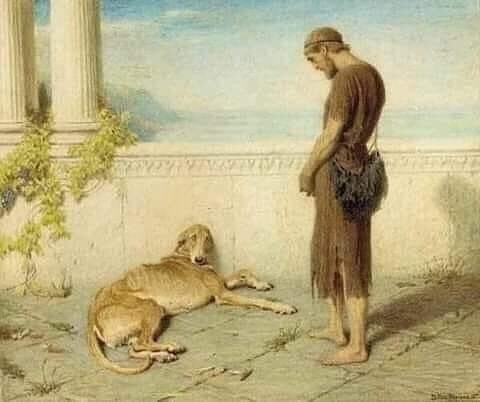
Briton Rivière, Argos and Odysseus, c. 1873. Oil on canvas.
Before you pluck a daisy down to its last petal — he loves me, he loves me not — consider what psychologists, brain scientists, and three thousand years of loyal dogs can actually tell us about whether your puppy loves you back.
Before you destroy a perfectly good daisy — he loves me, he loves me not — just think how often, looking into your puppy’s big eyes, floppy ears, and wagging tail, you’ve wondered: does my dog actually love me?
It’s a perfectly reasonable question. The answer, though, is complicated.
First, what is “love,” exactly? In a 1954 film, the crooners told us that love is “a many-splendored thing.” They were right. Let’s try to define it anyway.
If you asked Romeo and Juliet — the quintessential lovers — to define love, I suspect they’d be just as confused as the rest of us. Is it when your heart starts fluttering, blood rushes to your face, and you find yourself thinking you might spend the rest of your life with this person? If you asked the love doctor himself, renowned psychologist Robert Sternberg, he’d tell you human love is a trifecta of intimacy, passion, and commitment.
With dogs, it’s a little different.
What can Greyfriars Bobby, Hachikō, and Argos teach us about dog love?
Have you heard of Greyfriars Bobby, a small Skye Terrier from near Edinburgh, Scotland? Starting in 1858, the little dog mourned his owner’s death and guarded his grave for fourteen years. Or consider Hachikō, the devoted Akita born in 1923 in Odate, a small town near Tokyo. Every day, he waited for his owner, Professor Ueno, to return at Shibuya station. One day, the professor died suddenly and never came back — but his dog kept waiting, every day, for ten years. Go back further still, to Homer’s Argos, Odysseus’ faithful hunting dog. After twenty years away, a disguised Odysseus returns home to Ithaca — and who recognises him? Not his friends, not even his wife, but his aging, neglected dog, who wags his tail and dies peacefully at the sight of his master, one last time. Three stories, three thousand years apart, told and retold as symbols of loyalty and devotion. But is that the same thing as human love?
What does the science say about how dogs love?
The question of dog love has been studied not just by psychologists and storytellers, but by brain scientists. Thanks to modern imaging, we can now look inside a dog’s brain to see what happens when it hears — or especially smells — its owner. Evolutionary biology wired our brains to reward behaviour that helps us survive, especially the kind that helps us form groups. Humans and dogs, both being social animals, release the same pleasure hormone — oxytocin — in response to bonding. And since a dog’s sense of smell is many times stronger than ours, simply being near their person is its own kind of reward.
So — at the end of it all — your puppy loves you. If you’re ever gone for a long stretch and wonder whether your dog will remember you, rest assured: by scent, sound, or sight, they will. They may even wag their tail so hard they roll over trying to greet you.
Can dogs really commit to loving us?
Now, back to Sternberg’s trifecta. When it comes to you and your furry friend, there’s intimacy, certainly, and passion, without question. But commitment? The dictionary defines commitment as a firm promise or dedication to a future course of action. And there’s the catch: dogs live in a world made entirely of moments, with no real concept of the future.
Oh, come on, leave that poor daisy alone. Your dog can’t promise to love you tomorrow — they don’t have the concept. But that’s exactly why today’s tail-wag, today’s nose in your palm, today’s whole-body joy at the sound of your key in the door, isn’t a lesser love for lacking a promise. It’s just renewed.
Every single day, for no reason and with nothing at stake, they choose you again.
The pleasure they take in your face, your voice, your smell is incomparable — and it’s matched, exactly, by what you feel looking back at them.
So go play with your pup. There was never really a question.
Sternberg, R.J. (1998). Love Is a Story: A New Theory of Relationships. Oxford University Press.
Video source, on the neurochemistry of the dog–owner bond and oxytocin release: youtube.com/watch?v=ktIgM1qN4Lo
Video source, on dogs’ relationship with time and the present moment: youtube.com/watch?v=qHEG6UYc_8U